Showing posts with label animals. Show all posts

Sunday, September 25, 2011

Aquaria - boys day out


The boys wanted to go to Aquaria but JY was reluctant.
So DH took the boys to Aquaria and I went shopping with JY in KLCC for 2 hours.
For once, we had a blissful time shopping minus the boys running around and hiding under the displays and locking themselves in changing rooms.

Saturday, July 2, 2011

Buffaloes!

On our way to Melaka, we were faced with a four legged traffic stopper.


We waited patiently till the herd crossed the road to greener pastures,

Wednesday, April 27, 2011

Great Apes @Zoo Negara 25thApril2011

Our 3rd Education Programme in Zoo Negara. It was an early outing, starting at 9.15am as we had to be there to get an exclusive peek at how the zookeepers prepared the ape's enclosure before they were released into it.
It was also WL's birthday that day and we started off the morning with a birthday song, candles blowing and lots of birthday wishes. My boys made that cake. Fai mashed 3 cupfuls of bananas, Han whisked the batter and added a few eggshells for that extra crunch in the process.
The apes' enclosure was cleared of any leftover food from the day before. Then new food was brought in - banana stumps, banana leaves, bananas, coconuts and sugarcane. This was a treat for the apes, they were usually just given leaves.
Treats for the apes. The sugar cane was wrapped in a gunny sack.

This male chimpanzee got his hands on a bunch of bananas and a coconut clenched in his teeth.
The boys observing the chimpanzees.
Tearing the coconut open with its teeth with ease. Just bite and rip it out.
Then drink the sweet water in a few gulps.
From the chimpanzees, we went over to the orang utans. The male orang utans has bigger cheek pads and was much larger in size than the females.
The orang utans were more cautious and preferred to swing, climb and glance at us humans before they ventured out to get to the food.
The kids were asked to match the apes' feet, hands, eyes, hand print and eyes.
The apes' facial expression - fear, anger, happiness, sadness..
Then the kids had their hands taped so that their thumbs could not be used. This activity shows the kids how useful having opposable thumbs are.
It was difficult to hold the bottle.
It was took longer than usual pouring water out.
Trying to uncap a bottle of water was another tough one.
Peeling and cutting bananas without thumbs.
The Orang Utan's shirt could fit in 3 boys.
1 ape = strength of 6 men.
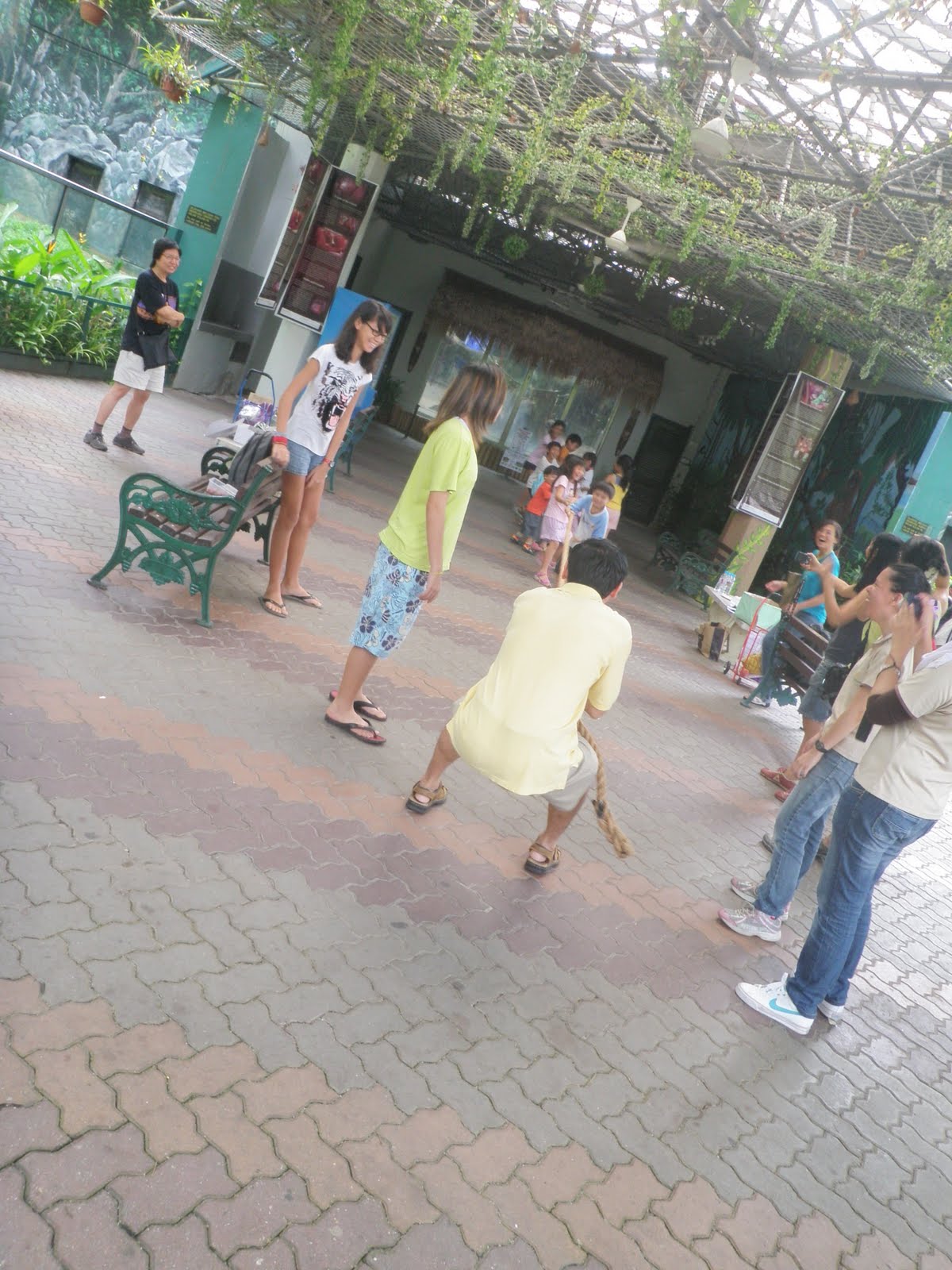
Here, the only daddy(1 ape) around had to play tug-a-war with about 10 kids(=6men?).

Daddy was no match for them.

Sunday, February 27, 2011

Zoo Negara II - tram ride & animal parts 24Feb2011


After lunch, it was time for a tram ride around the zoo. Edwina, our facilitator for the zoo education programme, graciously volunteered to be our guide and she gave lots of interesting snippets of the animals we passed by.

"Did you know that the goat's iris is rectangular?"

Other little questions to pique our interest as we zoomed through the zoo...
  • Do you know the difference between a horn and an antler?

  • Did you know our Malayan sun bear is the smallest bear in the world? What is the largest bear?

Baby giraffe is 1 year old. The other 3 female giraffes are pregnant.

The guided tour was very informative and I enjoyed my 30 minute ride.

After the ride, we stopped at Children's World. Fai pulled me into a cave with grisly exhibits. Elephant shoes anyone? Comes with elastic spongy cushioning.
Note the elephant's teeth. The boys remembered playing with elephant's teeth in K. Gandah

Shrinking skulls?
The smallest skull is the marmoset's and the largest is the baboon's.

Friday, February 25, 2011

Zoo Negara Educational Programme II - Encounter with Reptiles 24Feb2011

Our second education programme in Zoo Negara for the year and I was impressed with the effort put in. Once again we had Edwina as our facilitator.

She started by asking a series of questions:

  • Why were we at the zoo

  • What are reptiles

  • Name a few reptiles

  • What are cold blooded and warm blooded animals

  • What happens when cold blooded animals get too cold or too warm

Most of the questions were answered by the 6 to 8 year olds.


First activity of the day, tying your shoelaces without using your thumbs.

Not a single one of the kids had shoes with shoelaces.
Fai took off his sandles (with velcro straps) and slid his feet back in without using any fingers.
It was to illustrate the adaptabilty of humans and how having an opposable thumb enables us to do the simplest task.
She told the group that humans have adapted very well to its surroundings. Reptiles on the other hand being cold blooded had a harder time adapting to its environment. Its body temperature depends on its surroundings.
Edwina asked "What happens when a reptile gets too hot?"
En,7, replied "Well, when it gets too hot, it will go to a cool place"
Edwina "What about when it is too cold"
Fai " It will go out to the rock"

We walked to the reptilian section. Edwina gave an overview on all the reptiles that we walked past.

Edwina: How does a snake eat its much bigger prey?
En(while doing chewing movements with her fingers): It takes small bites
Fai: Ummm..(thinking and twiddling his thumbs)....

The group found the dead mice floating in the pythons' enclosure interesting

The dead mice being scooped up.
Mr Hafiz, the curator for the Amphibian and Reptilian exhibits, was around to answer our questions. He was a storehouse of information and was very willing to share his knowledge with us.

He said that the dead mice were killed by the pythons in the glass enclosure. They had killed the mice out of the thrill of of the hunt and could have also been a way to exercise their constrictor muscles. The snakes will not eat the mice once its body gets cold.
I asked if it was possible to limit the number of live mice put in. Hafiz said that if there isn't an excess number of mice, the bigger snakes might hunt and eat the smaller snakes. It had happened before but luckily the curator could intervene and managed to rescue the smaller snake.

Sniff like a snake activity.
Han said it smells like fondant.

Han took a tortoise egg from the display table and tried to crack it open by knocking it against the table. I stopped him in the nick of time. Phew!

JY and Thea was concerned about the life that might be growing inside the eggs. They said that they could feel the egg's contents. They asked why the kids were allowed to handle and shake the eggs.

Edwina explained that the eggs were not fertilised successfully and there wasn't any life within.

Snakes' skeletons draped on a tree branch.


Worksheet activity.
Match the eggs to the correct reptilian mother.
Petting a snake.
Ean couldn't keep his eyes off the python and insisted on giving it a pat.
Han inspecting the Star Tortoise's shell.

Han: " Look there is a bone in there! Why only one bone?"

Edwina who was next to him had to explain that the tortoise died and had to be removed, so only its shell is left.
He wasn't satisfied with the answer and kept asking for the missing bones.
The kids were provided with poster paint, paper and rocks for an arts and crafts session. They were encouraged to paint a reptile in its natural habitat.
Listening intently as Edwina pointed out the difference between a crocodile, an alligator and a false gharial.

Hafiz fed the Aldabra Giant Tortoise as the kids circled around the 60 year old tortoise and patted its shell.

I was inspired by David H. Albert's Skylark Sings book to get a pair of snakes for the boys.
So I quizzed Hafiz, who thinks that pythons make the best pets, on the snake's eating and breeding habits.
He had all the facts at his fingertips.
Interesting fact 1: Small snakes need to be fed once in 1 or 2 weeks. Larger snakes can go without food for up to a year. After they feed, they will shed their skin.
Breed your own white mice if you intend to keep snakes.
Interesting fact 2: We should only play with the snake after it sheds its skin.
Interesting fact 3: Keep snakes away from each other. They are cannibalistic.
Interesting fact 4: Snakes will eat house lizards

Aldabra Giant tortoise's poo. Looks like a clump of dried leaves and is odourless. We might take part in the poo art programme next. Making paper out of animal poo seems interesting :)

Bats 24Feb2011

The night before the zoo trip, Han started jumping around the bedroom with a blanket tightly clutch around his shoulders.
He said" I am gonna sleep like a bat tonight" and lay down on the bed.
Fai said "Bats sleep hanging upside down Han"
Han asked " Why do bats sleep upside down mom?"
I had no idea.
So I said, " Would you like to go to the bats exhibit when we are at the zoo tomorrow? Maybe we can find the answer there"
Han "Ok"

The largest bat is the Malaysian Flying Fox. We saw a few clinging to the black nursery netting. They were squirming and flapping their wings.
Me: the bats do not wrap their wings around them.
Fai: Yea, I think they are hot.

What fine deduction that was!

It was about 2pm.
The heat must have been unbearable for the bats with just the nursery netting for shade.

Thea: And too bright too. Don't they sleep in caves?

JY: Look. They are fanning themselves.

Indeed they were. The bats were flapping their wings inwards, trying to direct cool air to their body.

No information on why bats hang upside down but there were a few informative posters.
Fai compared the sizes of the bones in the human's and the bat's hand.
Han matched the bones of the bat's and human's.

Tuesday, February 22, 2011

By the beach @ PD 20Feb2011


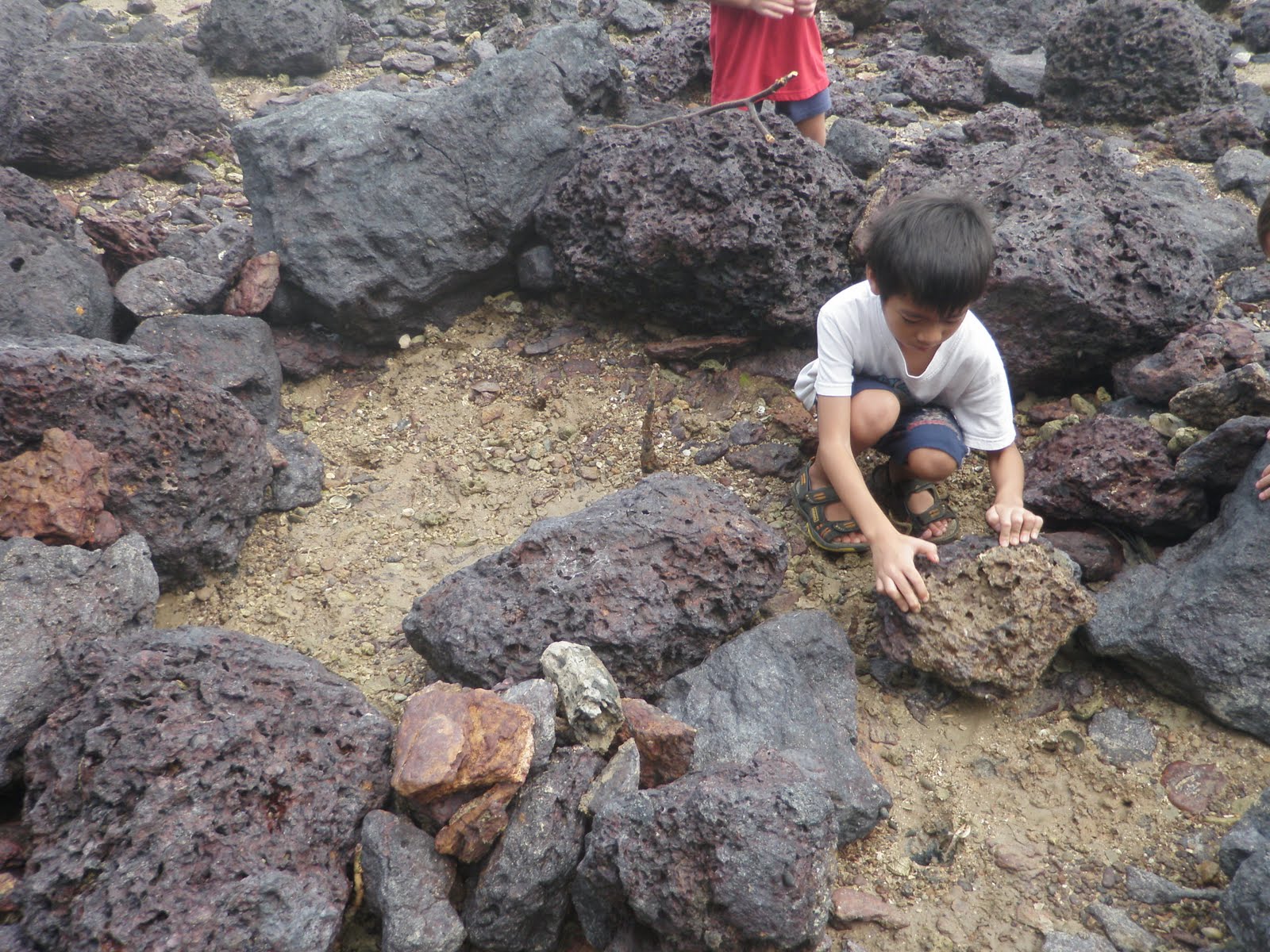
Fai building his fort. The stick placed on the rock behind him is his cannon. It is interesting to note that the rocks used in building the A Farmosa fort in Malacca is similar to the one Fai is using in this photo.

Fai found a tiny red lobster under a rock

Ean inspecting a mangrove tree's pencil root

Han pointing to a tiny black catfish in a rock pool.